
Brazil's Victory for Digital Sovereignty
Despite years of campaigning for impunity by the Bolsonaros and the American far right, a Supreme Court ruling has increased social media corporations' accountability for internet crimes.

Brazil's 1988 Constitution is recognized worldwide for its innovation in human rights and popular participation. Unfortunately, many laws created to further define its articles had loopholes slipped in by different interests in Congress. This has made enforcement challenging. Brazil now has a system where many of its most innovative laws, such as those requiring public participation in city planning, are respected by some local governments and ignored by others.
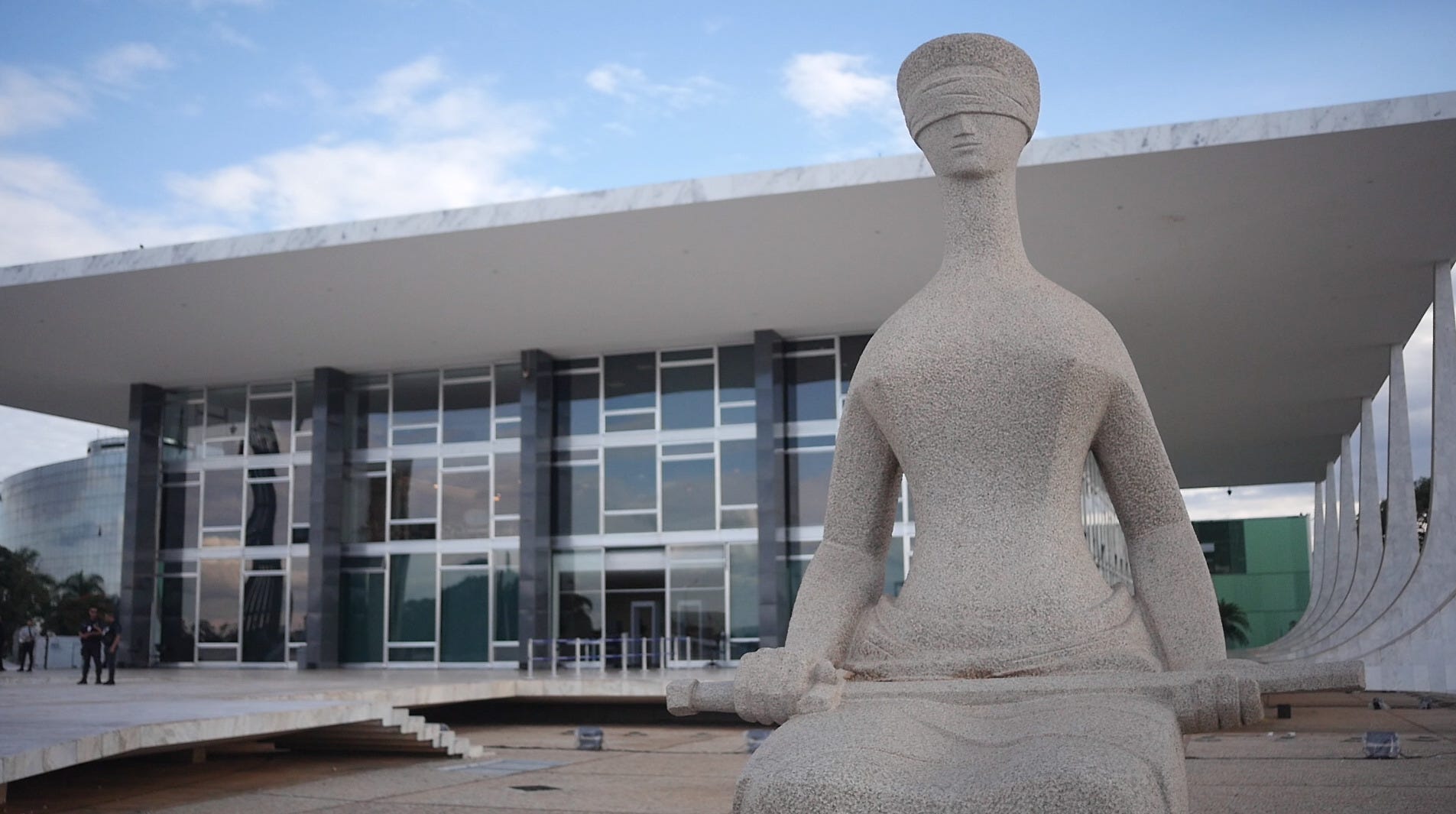
photo by author
One enforcement challenge has been holding social media corporations accountable for crimes committed on their platforms. Companies like X, Meta, Telegram, and Rumble have shown an apparent unwillingness to respect local laws in the countries where they operate. A key issue is that certain crimes are legal in the United States but not in Brazil or other countries like Germany and France. Examples include the promotion of pedophilia by groups like NAMBLA, neo-Nazism and apologies for human trafficking.
Many countries reject the U.S.'s concept of free speech absolutism. After all, this idea only gained traction in the U.S. during the 1970s when hardcore pornography was legalized and books like William S. Burroughs' Naked Lunch were no longer censored. In today’s current political climate of brutal repression of students protesting against the genocide in Gaza, it would be hard to argue that the US vision of free speech “absolutism” has worked there, much less that it should be emulated elsewhere. Regardless, Brazil’s more modern Constitution has a different legal approach to the issue, not prioritizing one essential right over others. In other words, it clearly defines a set of essential rights, including freedom of expression, but states that no essential right can be used to deny citizens access to any other.
For example, a group like NAMBLA would be illegal in Brazil because it denies children the right to a happy, stress-free childhood, as defined in the 1990 Statute of the Child and Adolescent. Similarly, paying a social media platform to spread baseless rumors of election fraud cannot be defended as free speech in Brazil because it is an example of using speech to weaken citizens’ essential right to free and fair elections.
In 2014, after years of debate, Brazil's Congress ratified Law 12.965/2014, the Internet Civil Framework. This law required social media companies to delete posts and deplatform users who broke Brazilian laws. However, it placed the burden on Brazilian courts to identify the posts and accounts.
Though well-intentioned, the law overwhelmed the court system with more work than it could handle. In cases where enforcement occurred, big social media companies and allies in the hegemonic media like The New York Times and Folha de S. Paulo, accused the judiciary of "authoritarianism." These accusations often relied on U.S. legal interpretations of free speech which have no standing in Brazil.
The campaign against Brazil's judiciary reached a climax in August 2024. After six months of disputes, X was pulled down in Brazil because Elon Musk refused to obey a local law requiring legal representation. Musk eventually caved after a month and agreed to comply. However, tensions flared again with the arrival of Donald Trump, whose inner circle has close ties to the Bolsonaro family.
As Republican lawmakers threatened sanctions against individual Brazilian Supreme Court justices, some worried that the Court might bow to external pressure. But on June 26, the Brazilian Supreme Court issued a landmark decision. It declared part of Article 19 of the Internet Civil Framework unconstitutional. In practical terms, the ruling increases accountability for certain types of internet crimes for the social media platforms that profit from them.
What changes
It's important to note that no new crimes have been defined. No change whatsoever has been made to Brazil's laws governing freedom of expression. All the new ruling does is provide for more efficient enforcement of existing crimes.
Before June 26, if teenagers were bombarded with Nazi propaganda promoting, for example, school massacres on Hitler's birthday (an event which caused a national crisis in 2023), someone would have to report it to the police, who would investigate and submit a request for a court order requiring the social media company to remove the content. This was a process that, at best, took days, and, in the case of X, which initially pushed back at removing the school shooting propaganda, often took weeks.
In terms of the life span of viralizing, paid promoted content, under the 2014 legislation, by the time posts were removed or users deplatformed, the damage was already done. This fact was made glaringly clear during Brazil's 2018 presidential campaign when millions of evangelical Christian voters were bombarded with doctored photos of baby bottles with penis shaped nipples on them and lied to that, as mayor of Sao Paulo, Jair Bolsonaro's opponent Fernando Haddad had distributed them in the city’s public preschool system.
According to the new framework, if someone informs the company that a user, or group of users is using their platform to commit crimes, it is legally obligated to remove the post. If it refuses it will be held legally co-liable for crimes which could include promotion of pedophilia, distribution of child pornography, hate crimes, or collaborating with Neo-Nazis.
In the case of criminal posts by anonymous accounts and/or bot farms, if the social media platform refuses to identify who posted them, it also becomes criminally responsible.
A problem in the past was that bots and individuals had multiple accounts posting the same or similar criminal information and a separate court order was needed for each specific URL. Now the service provider is obligated to act on a complaint and remove all similar illegal posts regardless of how many accounts they post it from.
In the case of illegal bot and other anonymous posts for which the social media companies receive payment for promoting through algorithm manipulation, they are immediately held liable. What this means is that the onus now falls on the company to verify that a paid promotion is legal at time of payment.
Social media platforms are now required to start specific moderation strategies for illegal posts that promote suicide, pedophilia, child pornography, human trafficking, racism, LGBT+ and gender discrimination. As one of the people who contributed to the legislation tells me off record, "this means that they have to develop strategies to mitigate risks. It doesn't mean that if one post slips through the cracks, they will be punished for it. But they will have to prove that they are acting proactively to reduce these kinds of crimes on their platforms. Let's say they do this and someone posts something with illegal content. The company will only be punished if it can't prove that it has taken the proper measures to lower the risks of this happening. It could show, for example, that it managed to remove 90% of the illegal content and that post made it through against their best efforts. In this case, it would not be held liable."
Not everything has changed, however. One provision from the former Civil Internet Framework which remains intact regards what in Brazilian law are referred to as "crimes of honor" like slander. Enforcement of these online crimes remains unchanged. Social media companies can only be forced to take down posts or deplatform users or groups of users upon receiving a court order. Enforcement of electoral crimes also remains unchanged, remaining entirely under the domain of Brazil's Federal Election Court system.
Nevertheless, Brazil's new civil internet framework is an important milestone in national sovereignty - a step forward in the battle against Silicon Valley's continual battle to weaken human rights and facilitate promotion of the technofascist ideologies supported by billionaires like Elon Musk and Peter Theil.
Meanwhile the ruling has upset many in the tech-billionaire-funded US libertarian community.
"There are many problems with this approach," warns the Cato Institute. "It forces platforms to review millions of posts every day to discover items not against their policies but against the laws of Brazil. Moderators and AI enforcement tools will be expected to be experts in Brazilian law..."
Frankly, this is the entire point. Brazil has the world's 4th largest number of social media users: 144 million. Meta corporation, which has 109 million regular users in Brazil, earned $162 billion in 2024. Why is it that CATO believes corporations like Meta would have such a hard time learning about Brazilian law? Wouldn't the most economically rational thing for a company to do in a situation like this be to hire some Brazilian lawyers? It certainly seems to be one of the primary messages that Brazil's judiciary has just sent up to Silicon Valley: learn our laws and obey them, or suffer the consequences like any other criminal organization.
Here's a translation of Brazil's new Internet Civil Framework. It's a good start for those who would like to lift Cato's gauntlet and take on what they seem to believe is the nearly impossible challenge of learning about Brazil's internet regulations.
June 26, 2025 Internet Civil Framework Ruling
Recognition of the Partial and Progressive Unconstitutionality of Article 19 of the Internet Civil Framework
1. Article 19 of Law No. 12,965/2014 (Internet Civil Framework), which requires a specific court order to hold internet application providers civilly liable for damages arising from content generated by third parties, is partially unconstitutional. There is a state of partial omission resulting from the fact that the general rule of Article 19 does not provide sufficient protection to constitutional legal interests of high relevance (protection of fundamental rights and democracy).
Interpretation of Article 19 of the Internet Civil Framework
2. Until new legislation is enacted, Article 19 of the Internet Civil Framework shall be interpreted such that internet application providers are subject to civil liability, except for the application of specific provisions of electoral legislation and normative acts issued by the Superior Electoral Court (TSE).
3. Internet application providers shall be held civilly liable, under the terms of Article 21 of the Internet Civil Framework, for damages arising from content generated by third parties in cases of crimes or unlawful acts, without prejudice to the duty to remove the content. The same rule applies in cases of accounts reported as inauthentic.
3.1. In cases of crimes against honor, Article 19 of the Internet Civil Framework applies, without prejudice to the possibility of removal through extrajudicial notification.
3.2. In cases of successive replications of offensive content already recognized by a judicial decision, all social network providers must remove publications with identical content, regardless of new judicial decisions, upon judicial or extrajudicial notification.
Presumption of Liability
4. A presumption of liability is established for providers in cases of unlawful content when it involves (a) paid advertisements and promotions; or (b) artificial distribution networks (chatbots or bots). In these cases, liability may be imposed regardless of notification. Providers shall be exempt from liability if they prove they acted diligently and within a reasonable time to make the content unavailable.
Duty of Care in Cases of Mass Circulation of Serious Unlawful Content
5. Internet application providers shall be liable if they fail to immediately make unavailable content that constitutes the following exhaustive list of serious criminal practices:
(a) Anti-democratic conduct and acts fitting the types defined in Articles 296, sole paragraph, 359-L, 359-M, 359-N, 359-P, and 359-R of the Penal Code;
(b) Terrorism crimes or preparatory acts for terrorism, as defined by Law No. 13,260/2016;
(c) Crimes of inducing, instigating, or assisting suicide or self-harm, under Article 122 of the Penal Code;
(d) Incitement to discrimination based on race, color, ethnicity, religion, national origin, sexuality, or gender identity (homophobic and transphobic conduct), which may be classified under Articles 20, 20-A, 20-B, and 20-C of Law No. 7,716/1989;
(e) Crimes committed against women due to their gender, including content that propagates hatred or aversion toward women (Law No. 11,340/06; Law No. 10,446/02; Law No. 14,192/21; Penal Code, Article 141, § 3º; Article 146-A; Article 147, § 1º; Article 147-A; and Article 147-B of the Penal Code);
(f) Sexual crimes against vulnerable persons, child pornography, and serious crimes against children and adolescents, under Articles 217-A, 218, 218-A, 218-B, and 218-C of the Penal Code and Articles 240, 241-A, 241-C, and 241-D of the Child and Adolescent Statute;
(g) Human trafficking (Penal Code, Article 149-A).
5.1. The liability of internet application providers under this item concerns the existence of systemic failure.
5.2. A systemic failure attributable to the internet application provider is deemed to occur when it fails to adopt adequate measures to prevent or remove the unlawful content listed above, constituting a violation of the duty to act responsibly, transparently, and cautiously.
5.3. Measures shall be considered adequate if, according to the state of the art, they provide the highest levels of security for the type of activity performed by the provider.
5.4. The existence of isolated, atomized unlawful content is not, by itself, sufficient to trigger liability under this item. However, in such cases, the liability regime under Article 21 of the Internet Civil Framework shall apply.
5.5. In the cases provided for in this item, the person responsible for the content removed by the internet application provider may judicially request its restoration by demonstrating the absence of unlawfulness. Even if the content is restored by court order, no indemnity shall be imposed on the provider.
Application of Article 19
6. Article 19 of the Internet Civil Framework applies to:
(a) Email service providers;
(b) Application providers whose primary purpose is conducting closed video or voice meetings;
(c) Instant messaging service providers (also called private messaging service providers), exclusively concerning interpersonal communications protected by the secrecy of communications (Article 5, XII, of the Federal Constitution of 1988).
Marketplaces
7. Internet application providers operating as marketplaces shall be civilly liable under the Consumer Protection Code (Law No. 8,078/90).
Additional Duties
8. Internet application providers shall establish self-regulation that necessarily includes a notification system, due process, and annual transparency reports regarding extrajudicial notifications, advertisements, and promotions.
9. They shall also provide specific customer service channels, preferably electronic, accessible to both users and non-users, which must be permanently and prominently displayed on their respective platforms.
10. These rules shall be published and periodically reviewed in a transparent and publicly accessible manner.
11. Internet application providers operating in Brazil must establish and maintain a headquarters and a representative in the country, whose identification and contact information shall be made available and easily accessible on their respective websites. This representation must grant the representative, necessarily a legal entity headquartered in the country, full powers to:
(a) Respond in administrative and judicial proceedings;
(b) Provide competent authorities with information regarding the provider’s operations, the rules and procedures used for content moderation and internal complaint management, transparency reports, monitoring, and systemic risk management, as well as rules for user profiling (where applicable), advertising, and paid content promotion;
(c) Comply with court orders; and
(d) Respond to and enforce any penalties, fines, or financial sanctions imposed on the represented entity, particularly for non-compliance with legal and judicial obligations.
Nature of Liability
12. There shall be no strict liability in the application of the thesis set forth herein.
Appeal to the Legislature
13. The National Congress is called upon to enact legislation capable of remedying the deficiencies of the current regime regarding the protection of fundamental rights.
Modulation of Temporal Effects
14. To preserve legal certainty, the effects of this decision are modulated and shall apply only prospectively, except for decisions that have already become final.